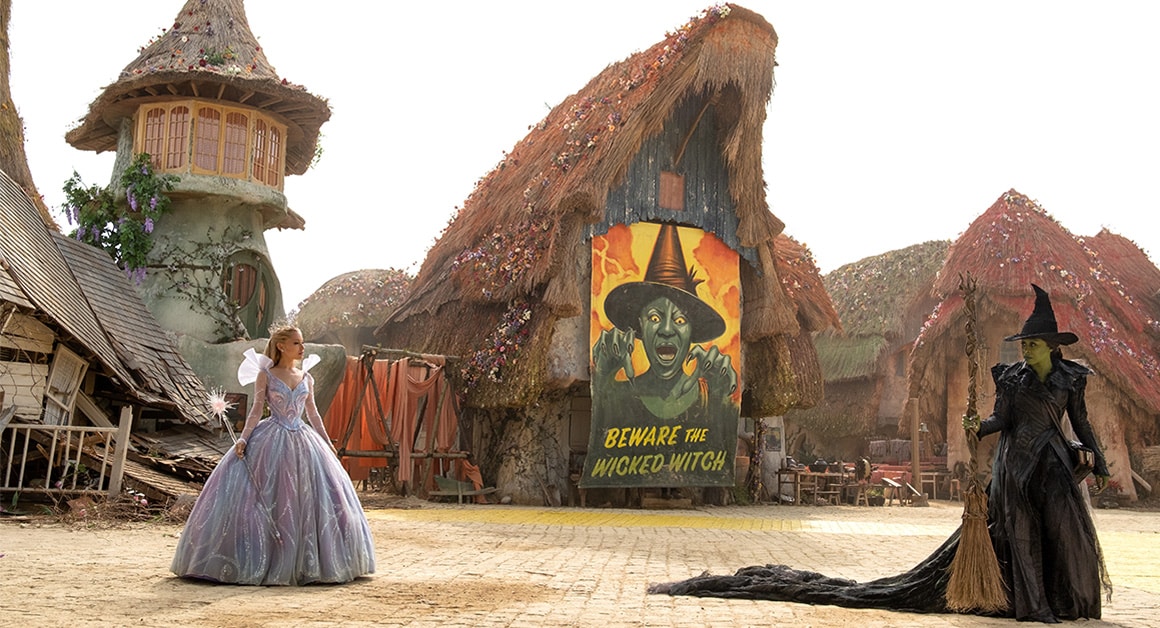
Oscar-winning costume designer, Paul Tazewell, is casting yet another fashion spell when it comes to the costumes for NBCUniversal’s film Wicked For Good. Directed by Jon M. Chu, the epic movie conclusion explores darker-toned themes of exile, heartbreak, and the consequences of the decisions we make whether “good” or “bad”. After defying gravity in part one, in part two, Cynthia Erivo, who portrays Elphaba, the Wicked Witch of the West, is banished from the Emerald City, living alone deep in the Ozian forest amongst the animals. While Ariana Grande, who charmingly plays Glinda the Good Witch of the North, works as a public figure for the Wizard and Madame Morrible living her life in a bubble, always bringing “good” news to the residents of Oz and Munchkinland.
Based on the novel by writer Gregory Maguire, Wicked For Good expands upon the story arc of these two witches, dissecting how they carry themselves as individual women no longer shielded by their youth, with their joint time at Shiz University. In part two, Elphaba finds herself fighting against the unnerving propaganda that is being written and said about her throughout the land by Emerald City Press Secretary, Madame Morrible. While the animals of Oz seek refuge from discriminatory laws that are causing persecution against them, the real question becomes, who will save them? Elphaba must go on another spellbinding journey and defy gravity even further to fight for what matters most to her. In comparison, Glinda Upland has become the symbol of goodness, carrying out her duties and soon to be wed to Prince Fiyero. But when life takes a turn and heartbreak occurs, Glinda has to dig deep to find the inner courage and gumption to stop the Wizard and Madame Morrible for good.
Screenwriters Winnie Holzman and Dana Fox cleverly weave in the characters of Dorothy, Tin Man, Scarecrow, and Lion from the classic 1939 film The Wizard of Oz, based on the original book by children’s author Lyman Frank Baum, into the storyline while still staying true to the source material for Wicked For Good. Paul Tazewell then took on the huge endeavor of creating hundreds of costumes for two films that were being shot simultaneously.
Last year, I interviewed Paul about his creative process in designing the costumes for the first Wicked film for ESSENCE. Since that feature, Paul Tazewell has gone on to make history, becoming the first black man ever to win an Oscar for Best Costume Design for the Wicked film. Now, for the upcoming Wicked For Good movie, Paul is putting even more magic into the intricate costumes for the film.
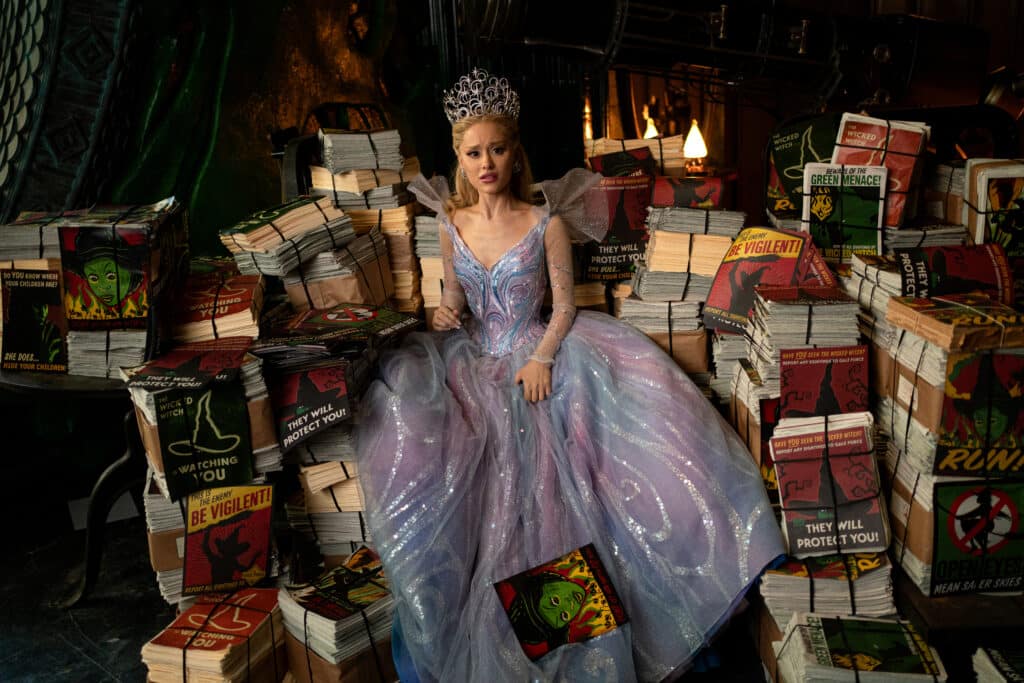
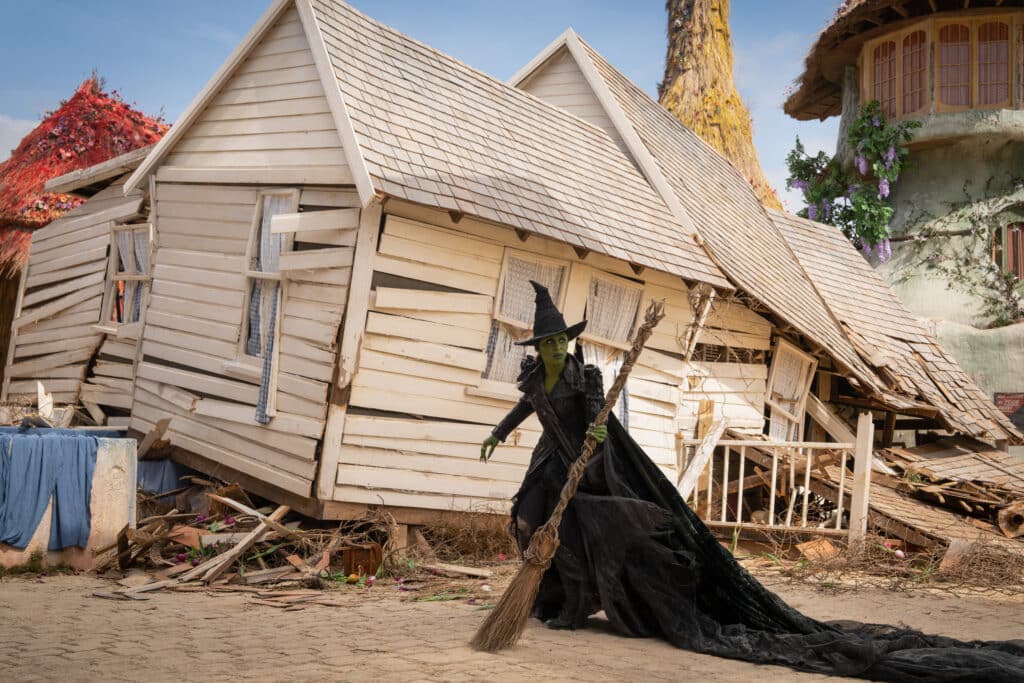
For Elphaba, we see Cynthia morph into her hero look as she takes on her full powers as the Wicked Witch. “With her costume evolution, the brim of her hat becomes wider, and the peak of it becomes taller, along with an expanded cape,” says Tazewell. For Glinda, Ariana continues to display class and sophistication through her looks, like the lavender bubble dress. ” For the skirt on the bubble dress, we used multiple layers of tulle and silk organza, which gives it this floating, lighter-than-air quality much like you would get with a bubble,” explains Tazewell.
Below, I speak exclusively with the Emmy-winning, Tony-winning, and Oscar-winning costume designer about his full process of creating these whimsical costumes.
Time To Defy Gravity Again
In the film, Elphaba steps into her full power as the Wicked Witch living in exile in the Ozian Forest. What was your process behind creating her hero look?
I thought about her complete costume track and asked myself, What is Elphaba’s sensibility? What defines her style? In Wicked For Good, I wanted to continue to project that she evolves style-wise in a truly powerful way. I wanted to create a nostalgic nod to the Wicked Witch of the West silhouette that Margaret Hamilton dons in the 1939 film The Wizard of Oz, but still keep Elphaba’s individuality and modernize how she would look today.
For the final act in Wicked, we see Cynthia defy gravity in this felted black dress ensemble, but for Wicked For Good, we see her transition into this coat silhouette that would allow us to acknowledge the trouser element and the knee-high boots. All of these aspects work together in tandem to create this bad-ass figure that is very agile and very athletic. In the opening scene, Jon M. Chu begins the film with Elphaba flying in and taking down several Ozian soldiers, so she needed to have this kind of power and nimbleness represented visually.
I reflected on this notion that if she’s active in being a hero, do the clothes around her deteriorate to reveal something truer to her inner character. This element is then incorporated into her costume with the frayed and tattered collar and lapels, as well as her cape.
The Girl In The Bubble
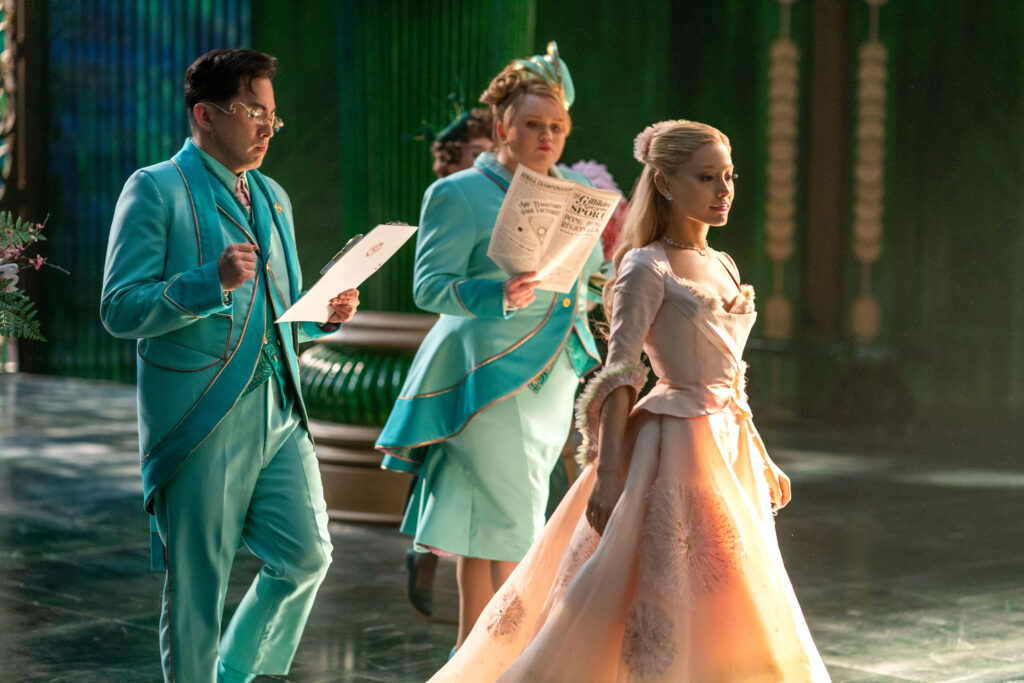
For Glinda, we see her become a “public figure” governing the business of Oz. What was the inspiration behind her business attire look?
In Wicked For Good, Glinda is instated in the offices of the Emerald City as this political figure by the Wizard and Madame Morrible to create this propagandist view of goodness. Visually, I had to craft an image that was elegant, sophisticated, and had this Hollywood glamour to it. I call it “The Dandelion Dress”, there are these big seeding dandelions embroidered on the skirt. When dandelions go to seed, the fronds start to peel off and float, feeding into elements of buoyancy that clearly represent Glinda, the Good Witch of the North. It’s also a costume that reflects this Marie-Antoinette fashion, with the sleeve having an engageante cuff (18th and 19th century, false sleeves originating from France) along with a diagonal sash that wraps around the front.
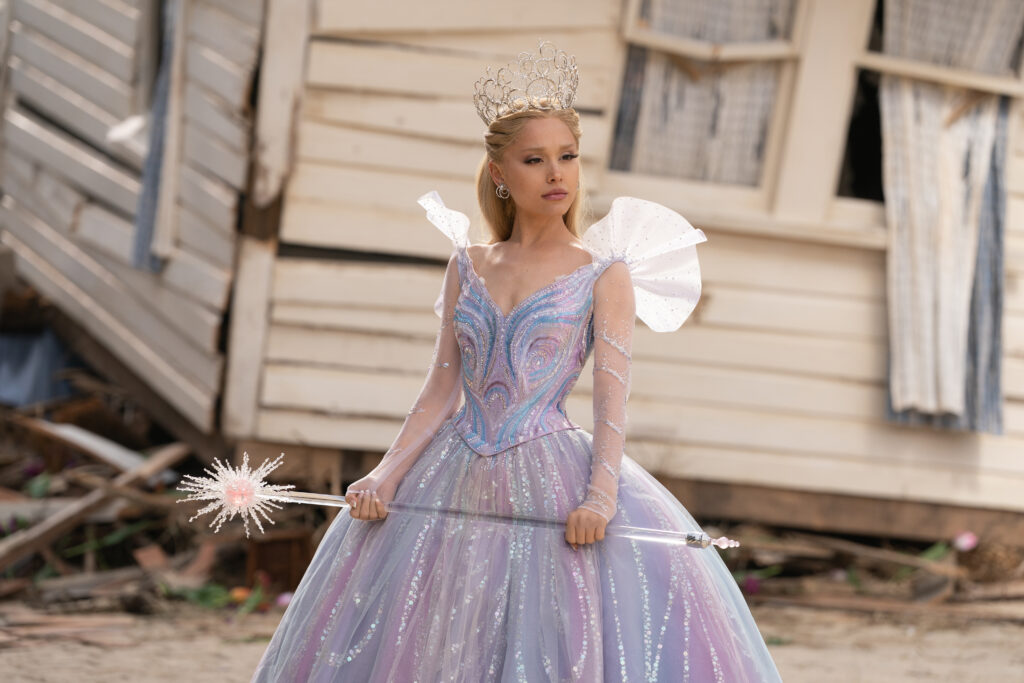
In Wicked For Good, we see Glinda in a lavender bubble dress versus the pink in Wicked. Why did you choose this color palette for the sequel film?
I wanted to pay respects to the original Wicked Broadway musical, where Glinda, played first by Kristin Chenoweth, wears a powder blue Dior-inspired dress, as well as use the silhouette shape from the dress Billie Bourke wears as Glinda in the 1939 film The Wizard of Oz. Ariana wears this very iconic bell-shaped skirt with multiple layers of tulle and silk organza that works up to this wasp waist with a simple sleeve. I crafted this costume to coincide with Billie Bourke’s, so when you see her ride down on her bubble in the opening scene, you get this same nostalgic feeling from watching Billie appear in The Wizard of Oz. When it pertains to the color palette being blue and lavender, I wanted to keep within this theme of colors you see in a luminous iridescent soap bubble.
After being with Elphaba in Kiamo Ko and singing “For Good” and coming to peace with their relationship, Glinda assumes Elphaba has died after seeing her melt behind closed doors, fighting Dorothy. So she must make a huge change, and that’s reflected in her persona. This change is displayed with the pink bubble dress after being gifted the Grimmerie, she then harnesses her own magical power and goodness that stems from an honest place.
The Most Oz-mazing Wedding To See
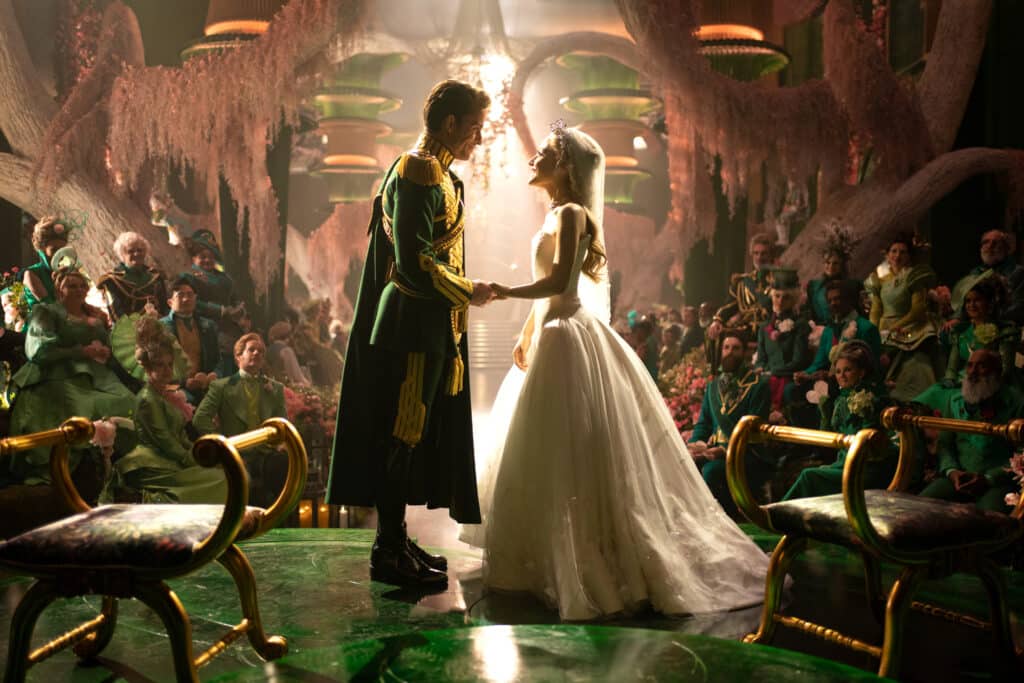
In the wedding scene, you dress Ariana Grande as Glinda in this gorgeous white gown with a voluminous overskirt. How did you go about crafting that type of costume for such a monumentous scene?
The challenge for the costume of the wedding dress was that it needed to be featured in several scenes leading up to their big day. It was designed to be an underdress that was then layered with a lavender overskirt that had an 82-foot-long veil attached. The wedding skirt features multiple layers of tulle, nylon net, and silk organza that create this bell shape. Swirling butterflies trail along the hem of her dress and throughout her veil, which is topped by her crystalized butterfly tiara. There is also this sense of vulnerability infused into her wedding dress. The asymmetrical bodice is very simple, but you have exposed arms, neck, and chest to evoke delicacy and prepare you for the heartbreak that is about to come with her and Fiyero.
For Fiyero, we see him become the Captain of the Gale Force. Explain how you mixed regality with military to create his costume?
The Gale Force is a special force for the Wizard, and I wanted their uniforms to be represented through this forest green color palette, emblazoned with gold bullion. The front plastron showcases this geometric design, resembling a staircase with gilded Ozian buttons. The silhouette is based on a Hussar or a Hungarian soldier. I also wove straw imagery into the backside of Fiyero’s costume, which nods to what he is to become at the end of the film.
Cynthia Erivo, who plays Elphaba, does a beautiful love scene with Jonathan Bailey, who plays Fiyero. In her home, we see Ephaba wear this delicate lingerie with this cozy knit sweater. What were some of the design choices behind this look?
Elphaba’s lingerie was purposefully knit so you could see her skin through the underwear. There isn’t an Ozian Victoria’s Secret, so I thought about how she would dress herself in her undergarments. Now donned the “Sex Cardigan,” I was looking for a knit sweater that looked like something she would wear in the forest. She’s surrounded by ivy, vines, roots, and bark as part of her environment, and from those elements, I wanted to create a knit that was soft, cozy, and brings her comfort. It also has a multifunctional aspect to it, with Elphaba and Fiyero using it as a blanket.
Who Can Stop The Wicked Witch?!
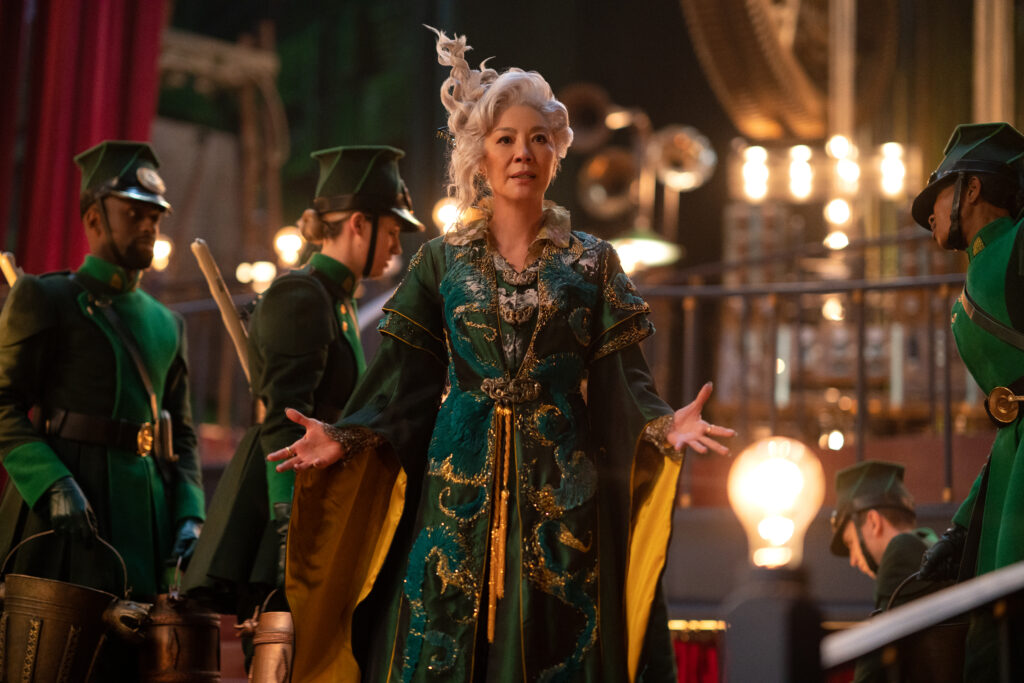
How did you create the emerald green costumes with weather-infused aspects for Michelle Yeoh’s character Madame Morrible?
In the opening scene, when Madame Morrible does her state address with Fiyero and Glinda, we see this militaristic side of Michelle Yeoh in this emerald green dress with the gold cording to match the Gale Force. Fast forward to the scene of her conjuring the tornado with the house that will be dropped on Nessarose, the Wicked Witch of the East, I dressed Madame Morrible in a gown made from velvet embroidered with gold and silver bullion with a pattern that resembles a lightning strike. Radiating from her torso, I wanted this pattern that explodes out in this wonderful electric pattern onto these hanging sleeves. The sleeves are lined with multiple layers of organza, as she’s conjuring, you see this resemblance to clouds, similar to how clouds form before a storm comes.
The Wizard is known for his trickery, tall tales, and shrouded past. How did you weave these character aspects into his costume for the second film?
For Jeff Goldblum’s number in “Wonderful,” I infused this Oscar-Wilde, laissez-faire attitude into his costume. The robe he wears has deep significance. I chose to weave this easter egg of the tangled poppy pattern along the front and hem of his dressing gown. These poppies are a nod to the scene in The Wizard of Oz where Dorothy, Scarecrow, Tin Man, and the Lion run across the poppy field and fall asleep. It also acknowledges his love affair with Elphaba’s mother, Mrs. Thropp, as the mystery lover with the bottle of elixir that makes Elphaba green.
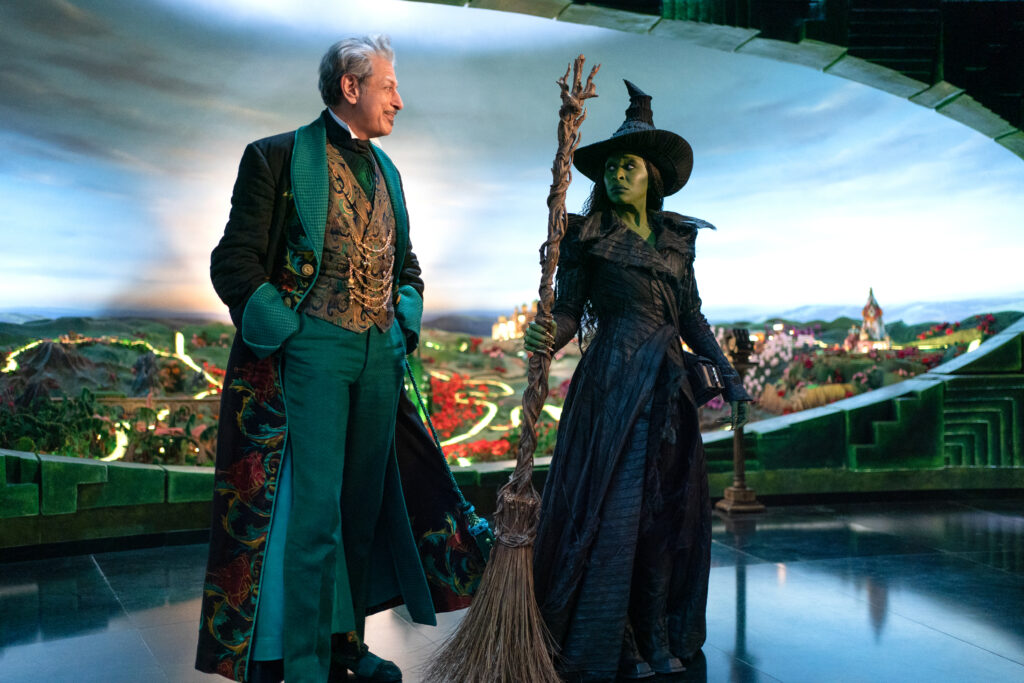
Did you pull inspiration from 18th and 19th-century fashion for the extras in the Wicked For Good film? We see many women in corseted gowns and the men with tall top hats.
It was definitely a Victorian, 19th-century exploration of fashion as well, incorporating turn-of-the-century and 1950s-esque inspiration. I was seeking to expand the silhouette capability, but still keep the cohesion through color palette, quality of fabric, and detailing.
What were some of the differences in designing the costumes for Wicked For Good versus Wicked? Who did you collaborate with for Glinda’s and Elphaba’s costumes?
I was designing it as one story, so Wicked also had to speak to Wicked For Good. We were going to experience our favorite characters in evolution, but they still had to inhabit some of the same spaces. My hope was to create a world where the audience wanted to wear the clothes for themselves.
Ian Frazer Wallace oversaw all of Glinda’s costumes for both films, and Jo Van Schuppen was the lead tailor for Elphaba, overseeing all her looks. Both were excellent tailors with amazing teams that brought consistency throughout each film. We also used the same team of custom beaders and embroiderers for all the costumes.
This interview has been edited and condensed for comprehensive clarity.